







For many of us, puja is not something we think deeply about every morning. It is simply part of the day. We wake up, freshen up, stand in front of the home mandir, light an agarbatti or batti, offer something to the deity and spend a few quiet moments in prayer.
Some families perform a detailed puja every day. Others keep it very simple. And that is perfectly natural. Every household has its own traditions, habits and way of worshipping.
But there is one small problem almost everyone who performs regular puja has experienced. You are ready for puja and suddenly realise that the camphor is finished. Or there are no cotton wicks left. The agarbatti packet has only one stick remaining. The Gangajal bottle is empty. And somehow, the matchbox that is always supposed to be near the mandir has disappeared again.
These are small things, but they are exactly why keeping your daily puja essentials together can make everyday worship a little simpler.
What are daily puja essentials?
There is no single list of puja items that every Hindu household must use. The items used for worship can change depending on your family tradition, region, deity, occasion and personal practice. A festival puja may require many special ingredients, while a simple morning or evening puja may need only a handful of things.
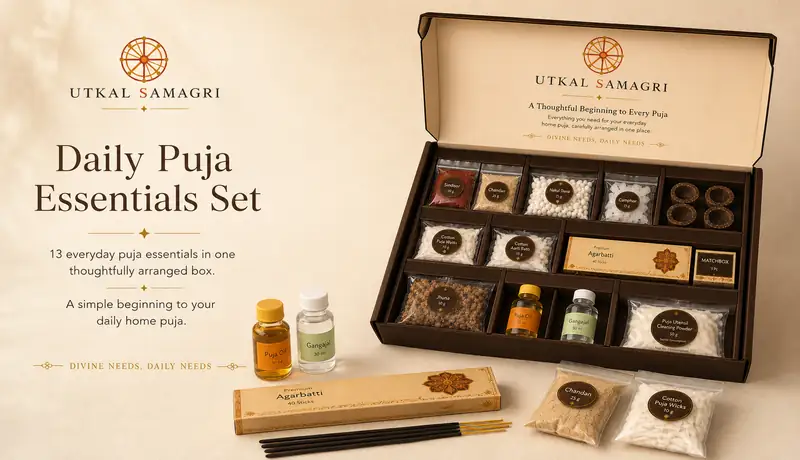
Still, there are certain items that are commonly found in home mandirs across India. At Utkal Samagri, we chose 13 such items for our first Daily Puja Essentials Set. Here is what each one is commonly used for.
1. Sindoor
Sindoor has an important place in many Hindu religious traditions. During worship, a small amount may be offered or applied according to the deity and the tradition followed by the household. Because only a little is generally required at a time, keeping it properly packed and readily available near the puja area is convenient.
2. Chandan Powder
The fragrance of chandan is something many of us immediately associate with temples and worship. Chandan powder can be mixed with a small quantity of water to prepare a paste and may be used during puja according to family tradition. It is traditionally associated with purity, calmness and devotion.
3. Nakul Dana – Bhog
Offering something to the deity before consuming it as prasad is a familiar practice in many Indian homes. Nakul Dana is a simple sweet item that can be used as bhog. It is convenient for everyday worship because it does not require preparation before every puja. After the offering, it may be shared as prasad according to the family's practice.
4. Camphor
Camphor, or karpoor, is commonly associated with aarti. Its bright flame and familiar fragrance are an important part of worship in many households. Because camphor burns quickly, it should always be used carefully on an appropriate holder and away from children or flammable materials.
5. Cotton Puja Wicks
Cotton puja wicks are probably among the most frequently used puja items. They are commonly placed in a diya with suitable oil or ghee and lit during worship. Because they are used regularly, they are also one of the items most likely to suddenly run out. Keeping an extra supply in your puja space can save that last-minute search.
6. Cotton Aarti Batti
Cotton Aarti Batti is another traditional item used while performing aarti. Although both regular puja wicks and aarti batti are made from cotton, their shape and intended use can differ. Families naturally use them according to their own puja practices.
7. Agarbatti
For many people, the fragrance of agarbatti is almost inseparable from the feeling of puja. Lighting incense helps create a calm and devotional atmosphere around the home mandir. Different people prefer different fragrances, but agarbatti remains one of the most commonly used puja essentials for home. It should always be placed securely in an incense holder and used in a properly ventilated area.
8. Sambrani Cups
Sambrani has a rich and distinctive fragrance traditionally associated with homes, temples and religious rituals. Ready-made Sambrani Cups make it easier to use without having to prepare sambrani separately. As Sambrani Cups become hot while burning, they should always be placed on a heat-resistant surface and should not be left unattended.
9. Jhuna
For us, Jhuna carries a particularly familiar connection with Odisha. Its aromatic smoke is commonly associated with puja and traditional religious practices in many Odia households. The smell of Jhuna can instantly remind someone of a temple, a family puja or a religious occasion at home. It is one of those simple traditional products that carries much more than just fragrance—it carries memory.
10. Diya Oil
Lighting a diya is an important part of worship in many Hindu households. Different homes use different oils or ghee according to tradition and preference. Keeping a small bottle of oil specifically for puja can make everyday preparation more organised and convenient. Our Daily Puja Essentials Set therefore includes 30 ml of Diya Oil intended for puja use.
11. Gangajal
Gangajal has deep religious significance and is kept in many Indian homes for worship and other religious occasions. Its exact use depends on the puja and the tradition followed by the household. Because only a small quantity may be required at a time, having a dedicated bottle in the puja area can be convenient.
12. Puja Utensil Cleaning Powder
Not everything connected with puja is part of the ritual itself. There is also the practical side. Brass, copper and other puja utensils need regular cleaning to keep them presentable. A dedicated Puja Utensil Cleaning Powder can therefore be useful for maintaining the items used around your mandir. It is not something you offer during puja. It is simply there to help take care of the puja utensils you use regularly.
13. Matchbox
This may be the simplest item in the entire set. It may also be one of the most useful. You can have camphor, agarbatti and cotton wicks ready, but none of them help much if you have to walk around the house looking for a matchbox. Keeping one matchbox specifically with your puja samagri solves a surprisingly common little problem.
Why keeping puja items together helps
Most daily puja items are small. That is exactly why they easily become scattered. Agarbatti may be in one drawer. Camphor may be somewhere else. Gangajal may be inside a cupboard. The cotton wicks may have been moved after the last puja.
Keeping commonly used items together makes it easier to see what you already have and what needs to be replenished. More importantly, it allows you to spend less time preparing and more time actually performing your puja.
The purpose is not to change anyone's tradition. It is simply to make the practical part of everyday worship easier.
What is inside the Utkal Samagri Daily Puja Essentials Set?
Our first product brings together 13 commonly used items:
| Item | Quantity |
|---|---|
| Sindoor | 20 g |
| Chandan Powder | 15 g |
| Nakul Dana – Bhog | 30 g |
| Camphor | 25 g |
| Cotton Puja Wicks | 10 g |
| Cotton Aarti Batti | 15 g |
| Agarbatti | 40 sticks |
| Sambrani Cups | 4 pcs |
| Jhuna | 30 g |
| Diya Oil | 30 ml |
| Gangajal | 30 ml |
| Puja Utensil Cleaning Powder | 50 g |
| Matchbox | 1 pc |
We call it the Utkal Samagri Daily Puja Essentials Set. The idea behind it is straightforward: bring useful everyday puja items together in one organised set instead of expecting someone to purchase and store every small item separately.
Why we are starting Utkal Samagri with puja essentials
Utkal Samagri is beginning small. And intentionally so. We could have tried to launch many different products at once, but we wanted our first product to solve a simple everyday need. Puja felt like the right place to begin. It is deeply connected with everyday life, family traditions and the habits that quietly continue from one generation to another.
Our name, Utkal Samagri, also reflects our connection with Odisha. As we grow, we hope to explore more products connected with puja, traditional ingredients, Odisha's food culture and other products rooted in the region. But that journey will happen step by step.
For now, we are beginning with one simple idea: keep the little things needed for everyday puja together, so preparing for prayer becomes a little easier.
Because tradition does not always need to become more complicated. Sometimes it simply needs to remain convenient enough to continue.
Utkal Samagri — Tradition for everyday life.